







The 1951 Flood: 75 years later
The 1951 Flood: Seventy-Five Years Later
On July 13, 1951, the Kansas River Valley experienced one of the costliest and most devastating floods in the area's history. Towns all along the river were inundated with water, particularly Kansas City, Lawrence, Manhattan and Topeka. North Topeka suffered the worst of the flooding, which destroyed many homes and businesses. The size of the devastation led to the 1951 flood being called “the flood of the century.”
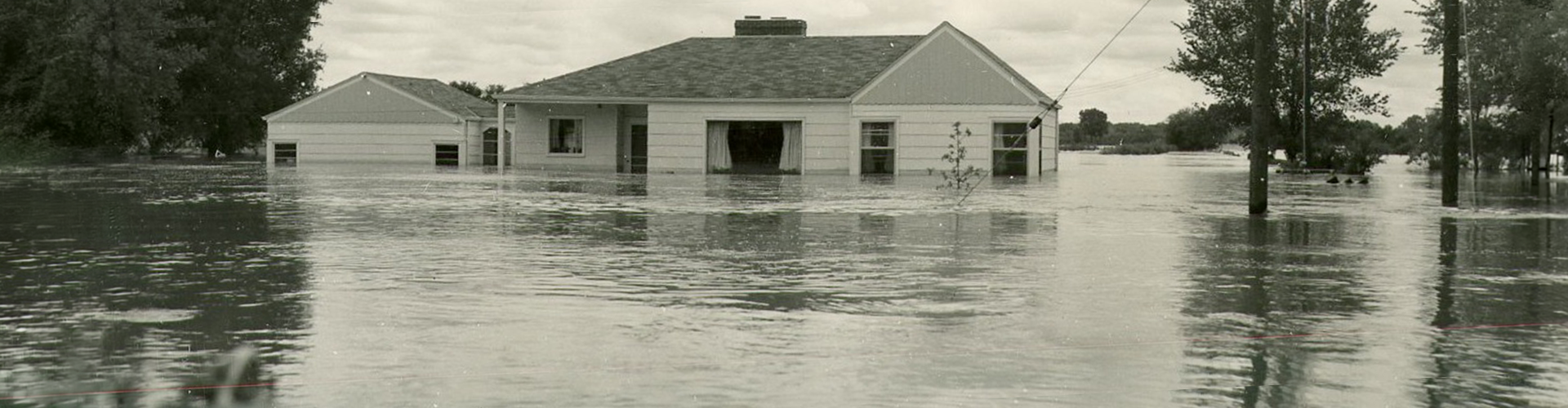
 The flood hit North Topeka the hardest, flooding out many of the homes and buildings north of the river. (TSCPL)
Waters rise
Late spring and early summer 1951 saw above-average rainfall. June of 1951 was, statewide, one of the wettest on record. A massive weather front had stalled across the state, resulting in seemingly unending rainstorms. By July 12, about 32 inches of rain had saturated northeast Kansas. In Topeka alone the rainwater runoff was calculated to be 6.81 million acre-feet or enough to cover an eighth of the state in one foot of water.
The Kansas River became a raging torrent of water flowing at 469,00 cubic feet per second. As the rain continued to fall, Topekans knew they were facing a flood the likes of which hadn’t been seen since the 1903 flood. Many began planning for the worst.
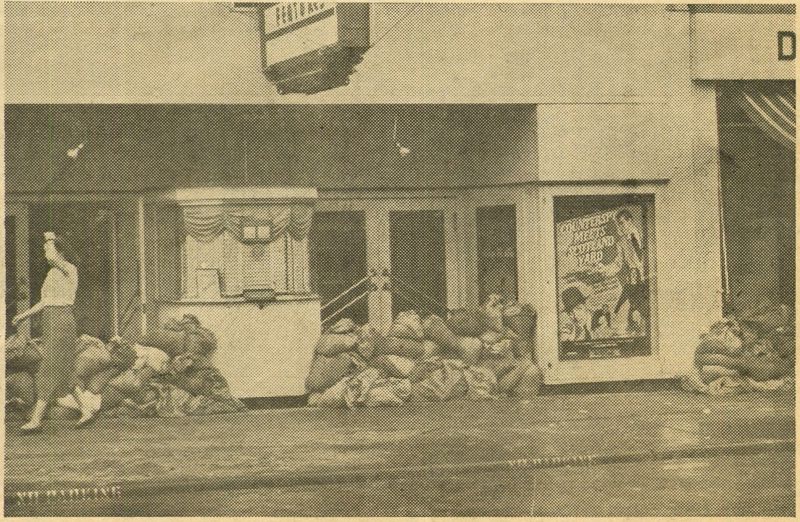 Many businesses in North Topeka began preparing for the flood by piling sandbags in front of doors and boarding up windows. These precautions did little good. (Image courtesy of the Topeka Daily-Capital)
Those who owned homes and businesses close to the river began to board up their windows and place sandbags around the buildings. Several store owners in North Topeka began to move their inventories either onto high counters and shelves or to storage facilities on the other side of the river. Homeowners hoped the flood water wouldn’t rise beyond the second floor and stored their furniture there.
Many people evacuated their homes and went to higher ground. Several churches and auditoriums opened their doors to the evacuees, and a disaster headquarters was set up at Topeka’s Municipal Auditorium. By Friday, July 13, 3,500 people were registered for food and shelter.
City officials had two major concerns: the water supply and the power plant. As the river level rose, the water surrounded both Topeka’s water plant and the nearby power plant at Tecumseh, threatening the city’s supply of drinking water and electrical supply.
After a public call for help from the mayor, 5,000 citizens and national guard soldiers formed a human chain to carry hundreds of thousands of sandbags to the water plant, saving it from the flood and ensuring Topeka kept its supply of potable water.
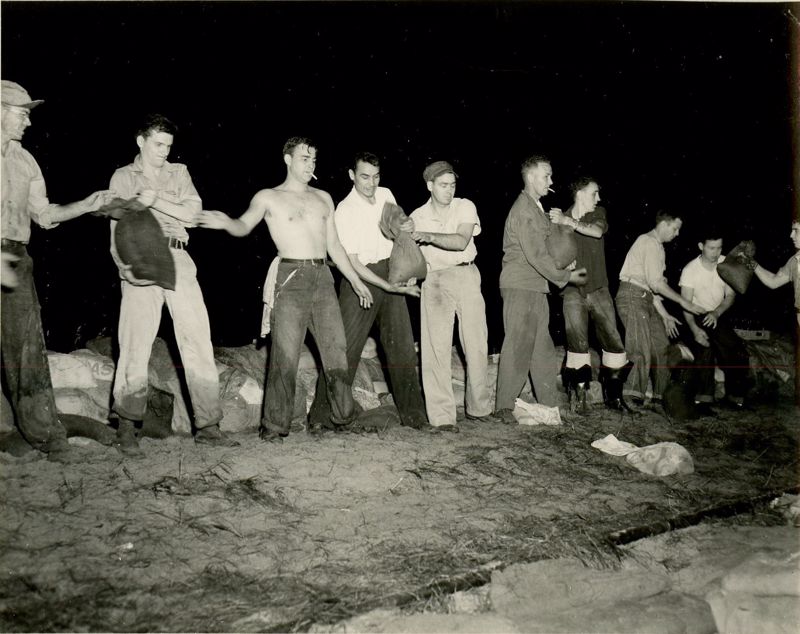 Thousands of volunteers and national guardsmen lined up and worked day and night passing sandbags to save the Topeka Waterworks plant. (TSCPL)
At the Tecumseh Power Plant employees worked around the clock to surround the plant with piles of coal, forming dikes that kept the plant from flooding. Unlike other towns in the vicinity, Topekans were able to keep the lights on.
The dam breaks
Early in the morning of July 12 the battered dikes that protected North Topeka finally broke. River water poured into the North Topeka business district, covering some areas in more than 20 feet of water. Those who had chosen to stay in their homes were stranded and many were forced up onto their roofs to await rescue.
The Topeka Boulevard bridge was quickly set up to be a make-shift dock for rescue boats. By the end of the day on July 12, more than 700 North Topeka residents were evacuated by boat. One refugee, Mildred Lohness, later recalled her family’s evacuation boat ride, saying “we would hit some treetops and then have to wait while a house sailed by. It would’ve scared the socks off of anyone!
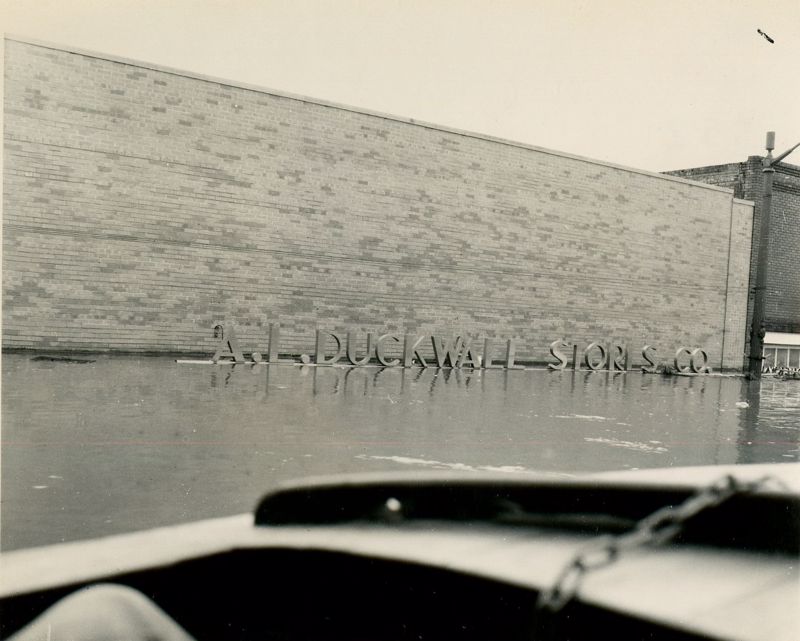 The sign at the front of the A.L. Duckwalls Store in North Topeka was all that could be seen above the flood waters. (TSCPL)
Those who had left a few days earlier realized they would not be able to get back into their homes anytime soon. When Gary Owen’s family evacuated their home on July 11, 1951, they only took the clothes they were wearing. “We thought we’d be back the next day,” Owen later said. “It was three months before we got back into the house.
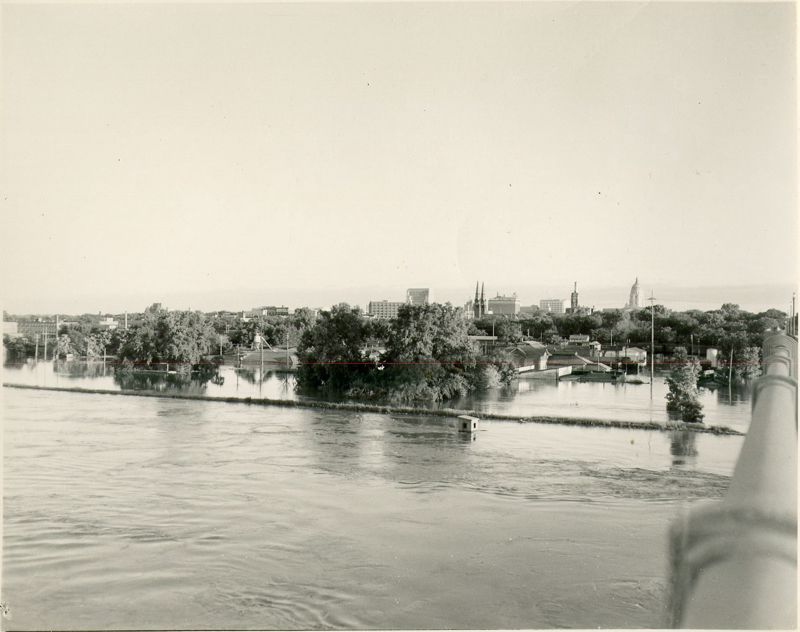
On Friday, July 13, the river crested 36.4 feet, three feet higher than the 1903 flood and the highest in the city’s 96-year history. One-third of the county was underwater. Topekans standing at the intersection of 3rd St and Kansas Ave reported that, when they looked north, there was nothing but water as far as they could see. This led to the U.S. Weather Bureau designating July 13 “the single day of greatest flood destruction in Midwestern United States history.
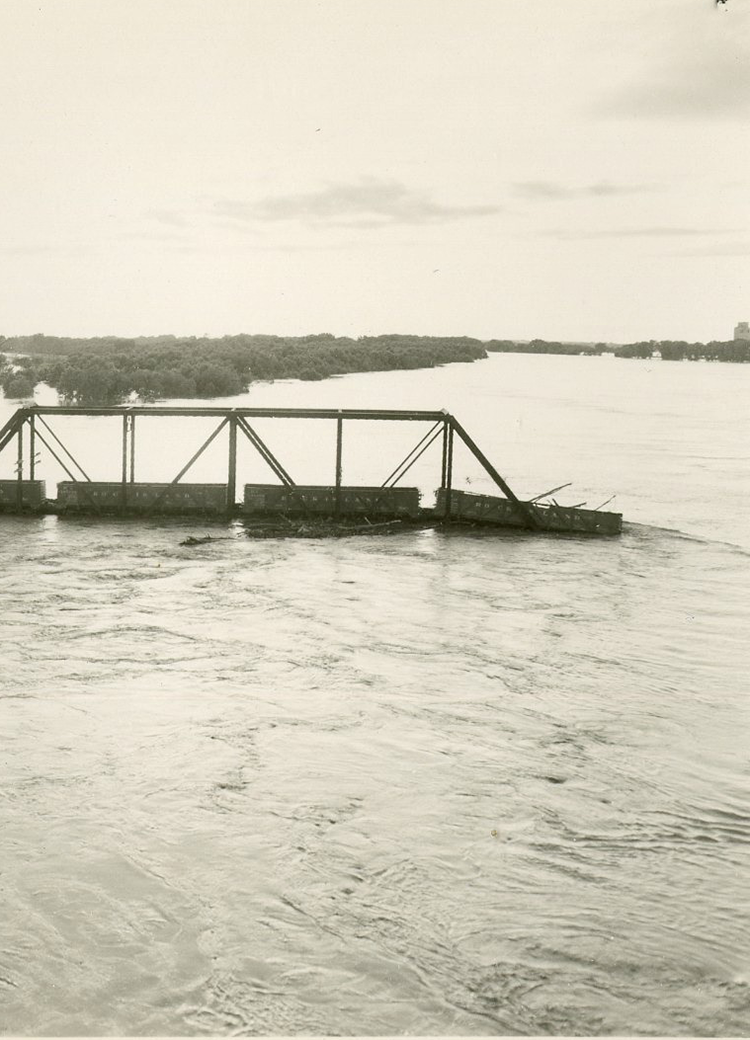
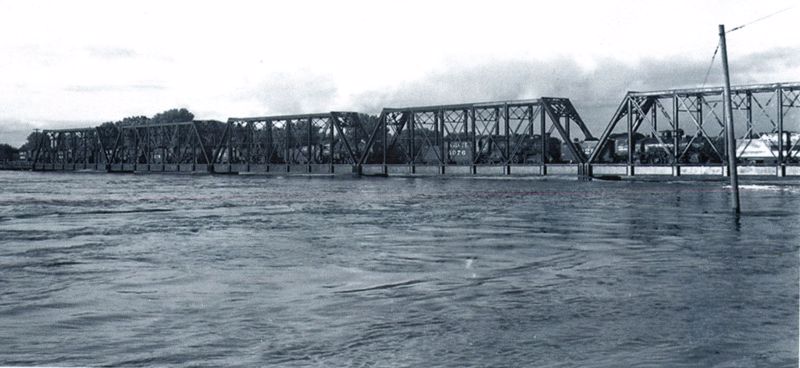 The Santa Fe railroad attempted to save its bridge across the Kansas River by loading it with train engines and train cars. The bridge was still destroyed by the raging river and took the train equipment with it. (William A. Gibson collection, TSCPL)
Throughout Kansas and Missouri 186 towns and 2.5 million acres were flooded. More than 87,000 people were forced to leave their homes and nearly 3,900 businesses were affected. While no one in Topeka died as a direct result of the flood, the U.S. Geological Survey stated that 19 people were killed and 1,100 were injured in Kansas and Missouri because of the flood.
Recovery efforts
After several days the flood waters began to recede and people were able to return to their homes and businesses to assess the damage. What they found was even worse than they feared. Vic Black, the manager of the Ben Franklin variety store in North Topeka, found the store’s floors covered in three to four feet of foul-smelling mud.
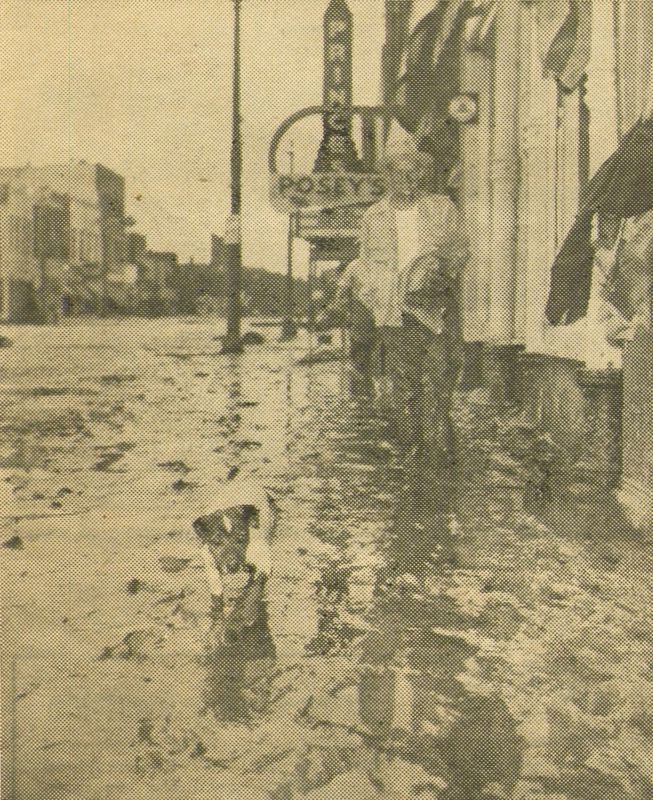 An unidentified man and his dog struggle through the mud-covered sidewalks in North Topeka. Many who experienced the flood remember how bad the mud and stagnant water smelled. (Topeka Daily Capital)
Lew Paramore returned to his home to find most of the furniture had crashed through his living room window and was sitting on the front lawn. Before evacuating Paramore had stacked items in the grocery store he owned high on shelves. He later recalled “I might as well have thrown them in the basement for all the good that did.” Everything was ruined.
Arlene (Elder) Felch’s family found their home was still standing after the flood, but part of the basement wall had caved in, letting a section of the kitchen floor drop into the basement. One of her most vivid recollections was seeing the canning jars stuck to the ceiling.
While there were those who decided to move away and start fresh, many Topekans stayed put, rolled up their sleeves and began the tedious process of digging out of the mud and debris. Approximately 29,000 Topekans were unhoused from the flood, so the city applied to the federal government for a fleet of trailers to be sent to help. The first arrived in August 1951, but with other cities also needing assistance, it wouldn’t be until January 1952 that there were enough trailers for all those who needed housing.
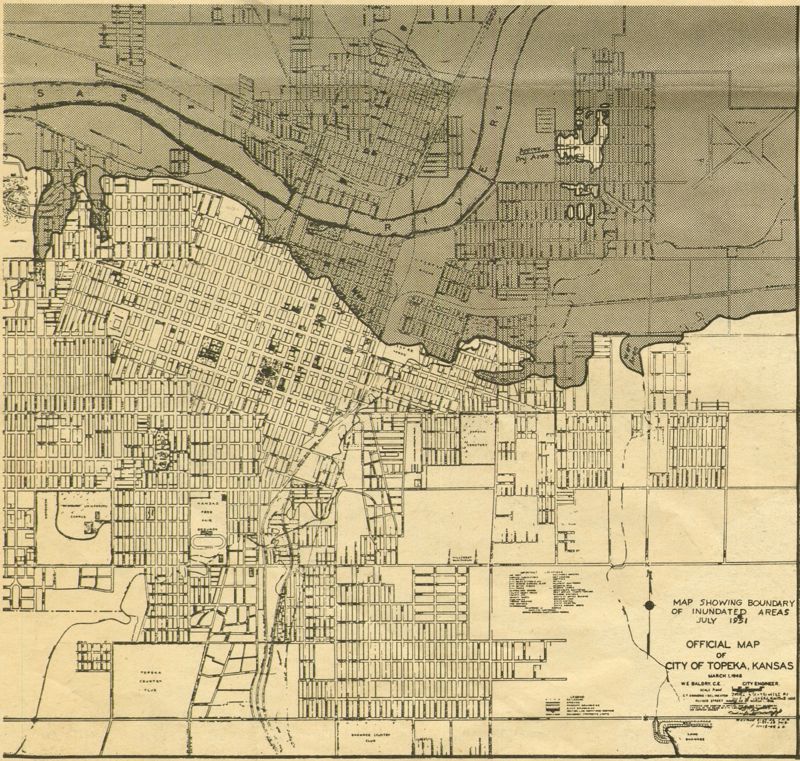 This map shows the areas that were flooded out during the July 1951 flooding. All of North Topeka and Oakland were underwater. (TSCPL)
North Topeka made a surprisingly swift recovery and many businesses were able to reopen in time for the Christmas shopping season. Businesses touted that it was the resilience of everyday Topekans that could account for this quick recovery. In the December 1951 edition of the Shawnee County Historical Society’s Bulletin, A.J. Carruth wrote: “Topeka will not suffer long from this calamity – that is, from its visible effects, because its citizenry is too loyal and proud and generous to allow the flood to leave its marks.
75 years later
While Topeka overall recovered from the 1951 flood, there were lasting repercussions. When all was said and done, flood loss in Topeka alone was estimated to be $34.1 million (almost $500 million today). During the flood 24,000 people were evacuated from homes in Topeka, and 6,950 dwellings and 530 businesses were damaged or destroyed. With total losses in both Kansas and Missouri coming to almost $1 billion (almost $13 billion today), the 1951 flood still stands as one of the greatest on record in terms of damage, according to the U.S. Department of Commerce.
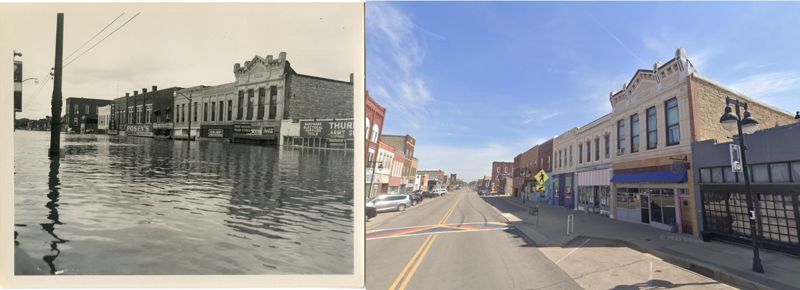 While the names on the buildings may have changed, this block of Kansas Avenue in North Topeka remains relatively unchanged since 1951. (TSCPL & Googlemaps)
After the flood many mitigation projects were undertaken including the creation of the Tuttle Creek Reservoir and the Topeka Flood Protection Program, which required new levees to be built along the river. But even with these protections, the Kansas River Valley has still seen floods, especially the 1993 flood. Time will tell if we see another flood the caliber of the 1951 flood.
To see more images from the 1951 flood, visit our local history digital collections page!