







Local History: The rise and fall of Topeka's Melan Bridge
Local History: The Rise and Fall of Topeka's Melan Bridge
The history of Topeka has always been tied to the Kansas River. In the 1840s the Papan brothers began operating a ferry across the river to accommodate soldiers traveling from Fort Leavenworth to Mexico. A few years later Cyrus K. Holliday and the other members of the Topeka Town Association chose a site close to the ferry landing to start their new town and many of the first businesses catered to the needs of travelers crossing the river.
During the next 40 years several bridges were constructed to take the place of Papan’s ferry, but they all were destroyed by floods or were eventually deemed too unsafe to cross. It wasn’t until 1898 that Topeka built a bridge connecting Topeka and North Topeka that was projected to last as long as the city. This is story of Topeka’s historic Melan Bridge.
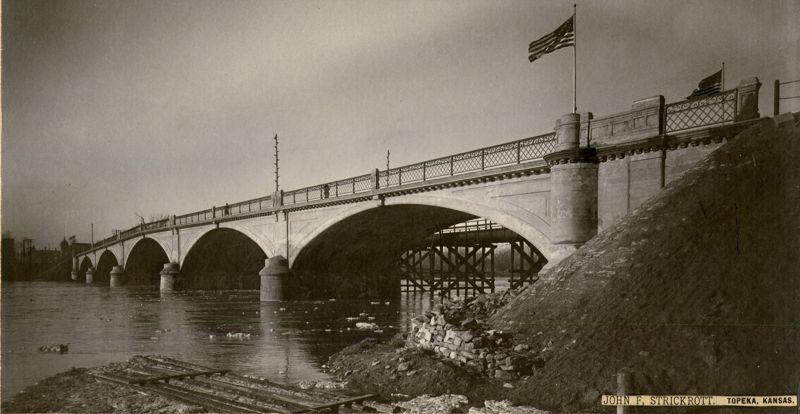 The Melan bridge as seen from the north side of the Kansas River. (TSCPL)
“The Best and Handsomest Bridge”
By 1895 Topekans had seen several bridges span the Kansas River. The first, a wooden bridge located close to the Papan’s ferry landing, opened in May 1858, but was destroyed by a flood only two months later. In 1870 an iron-work bowstring bridge was erected in the same area. It too was repeatedly damaged by flooding and by 1880 was deemed unsafe to use.
On March 1, 1895, the Shawnee County Commission approved an election so the public could decide if bonds should be issued to construct a new bridge. Voters approved the bond issue and the commission began to entertain design submissions for the new structure.
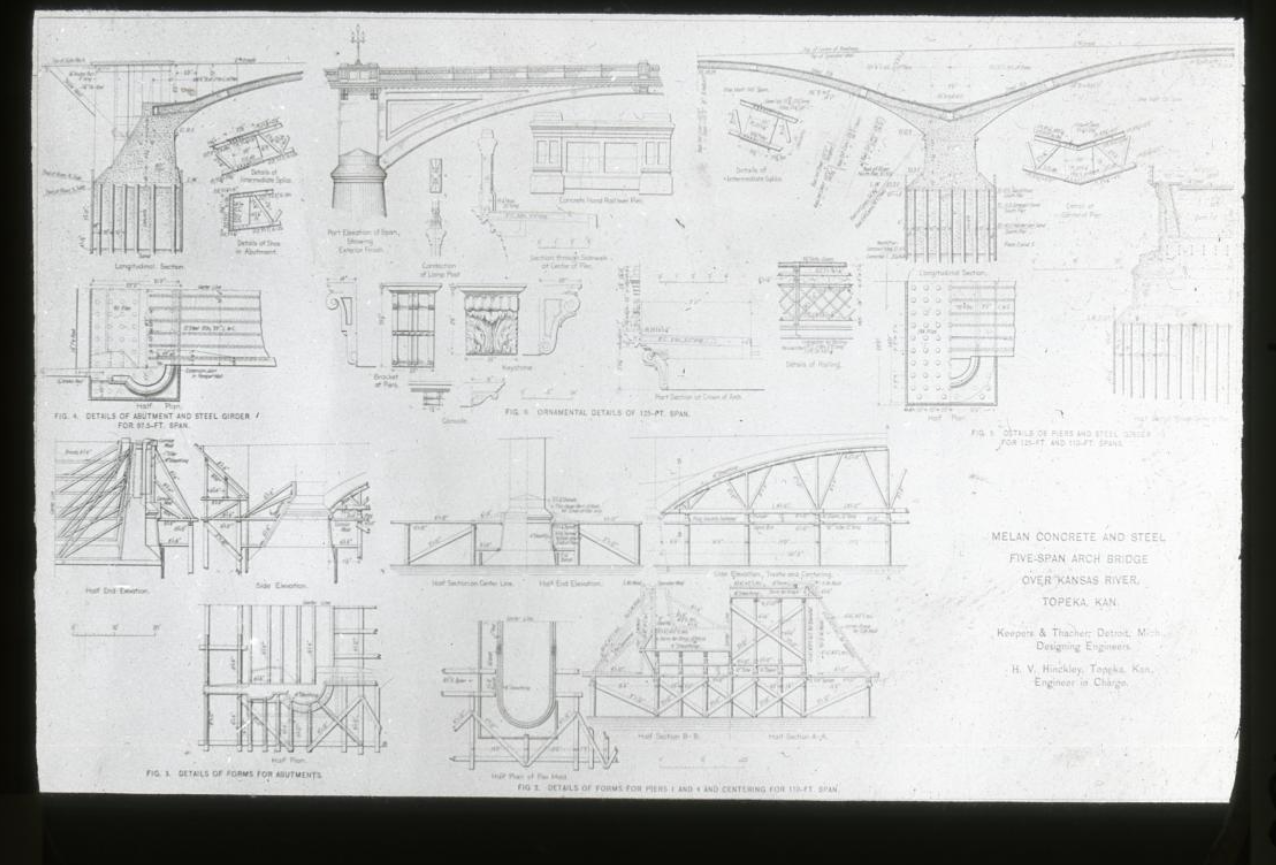 A copy of the blueprints for Topeka's Melan bridge are housed in the Smithsonian Institutions National Museum of American History (Division of Work and Industry Lantern Slide Collection, 1758-1945, Archives Center, National Museum of American History.)
One of the most promising came from Colonel William Tweedale who had read of a newly patented design by Josef Melan an Austrian engineer. Melan’s bridge design used arch steel beams set in concrete, making it stronger than many other contemporary designs. It could also be built quickly. The county commissioners were impressed both by the innovation of the design and by the fact that it could be built for $15,000 less than they had budgeted.
In early October 1896 the old bowstring bridge was rolled over onto temporary piles so there would still be a bridge connecting Topeka and North Topeka, and construction of the Melan bridge began.
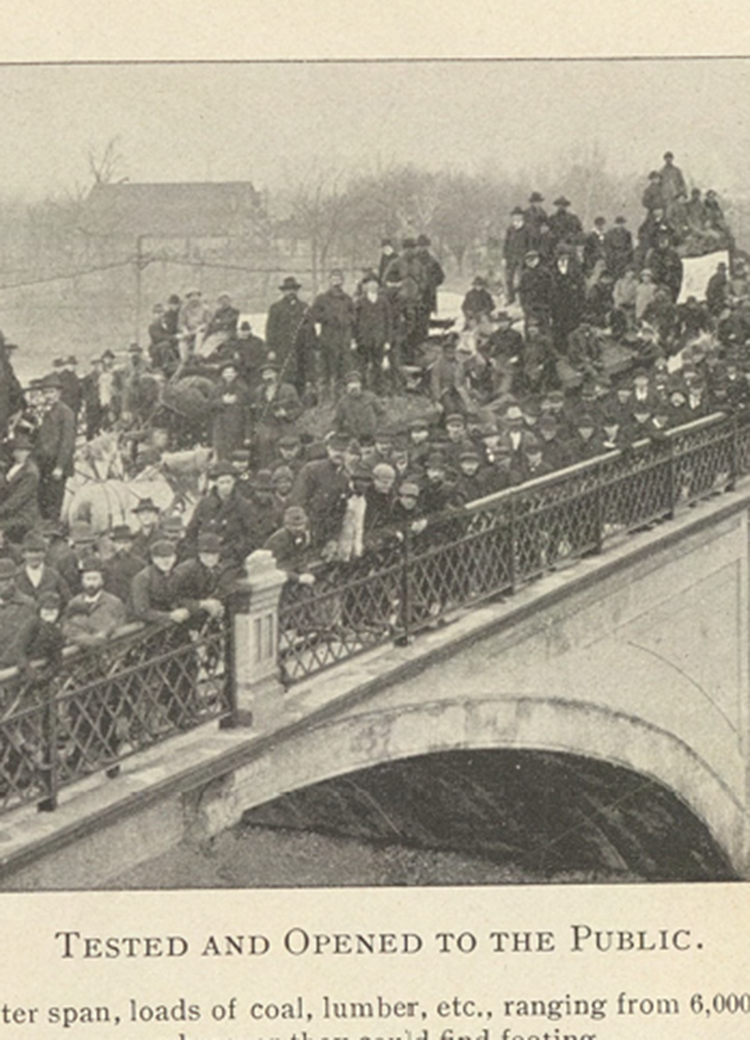
After just over a year the new Kansas Avenue bridge was opened to traffic. It spanned 646 feet across the river and was made up of five “spans” or arches. At the time, it was the largest Melan arch bridge in the world. According to newspaper accounts of the celebration, hundreds of people walked back and forth across the structure after it was weight tested.
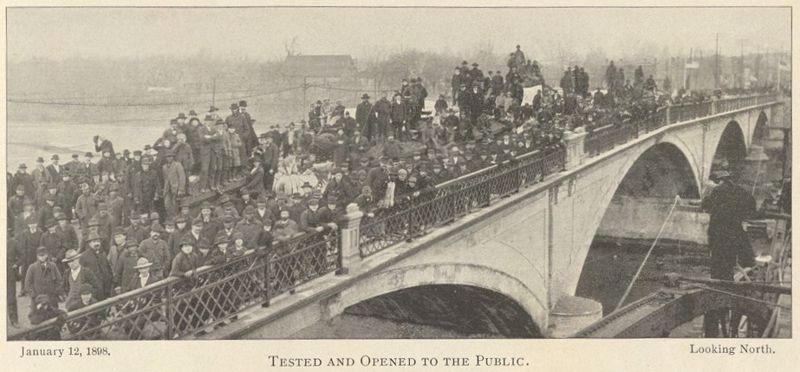 Even though it was a cold day, a large crowd gathered to celebrate the opening of the Melan bridge. (TSCPL)
Floodwaters rise
One of the first true tests of the Melan bridge’s strength came in 1903 when the Kansas River rose to 38.5 feet. Other bridges across the river were quickly swept away. The Melan bridge mostly held firm, but both ends of the bridge were swept away, requiring the city to add two additional spans to either end.
During the 1951 flood the Melan bridge was one of the only bridges in Topeka to remain standing after the river receded. And while many Topekans saw this as a testament to the sturdiness of the structure, a design flaw was brought to light with the flood. The arches of the bridge were not high enough to allow for debris and driftwood to pass through, creating a dam that only made the flooding of the area around the bridge worse.
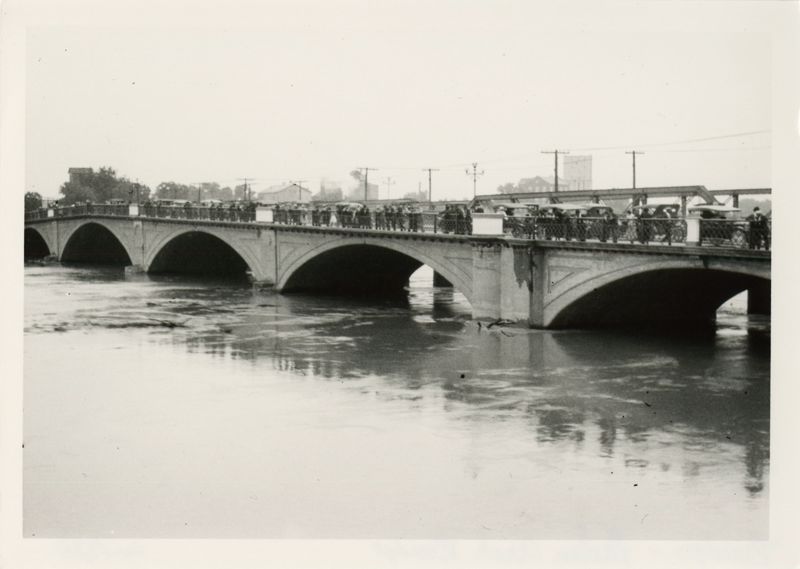 While the Melan bridge withstood several floods, each one wore away more and more of the concrete pilings holding the bridge up. (TSCPL)
The 1951 flood led to the creation of the Topeka Flood Protection Program, which required new levees to be built along the river. But these would put the Melan bridge 12 feet below the new possible flood stage. Topeka officials knew a new bridge would be needed, but finding the funding proved difficult.
A day of tragedy
Over the next decade the bridge stayed open, but engineers began to notice serious signs of wear. City Engineer Abram Pratt reported during one inspection of the pilings in the winter of 1965 he discovered handfuls of concrete could be peeled off the supports. By this point the bridge was carrying 12,800 vehicles a day, as well as the water, gas and telephone lines that serviced North Topeka.
By August 1964 funding had been secured for a new bridge and construction had begun. But on the evening of July 2, 1965, tragedy struck. At 5:30 pm, in the middle of rush hour traffic, a large section of the bridge just north of the south approach collapsed, sending 300 feet of roadway and debris into the river.
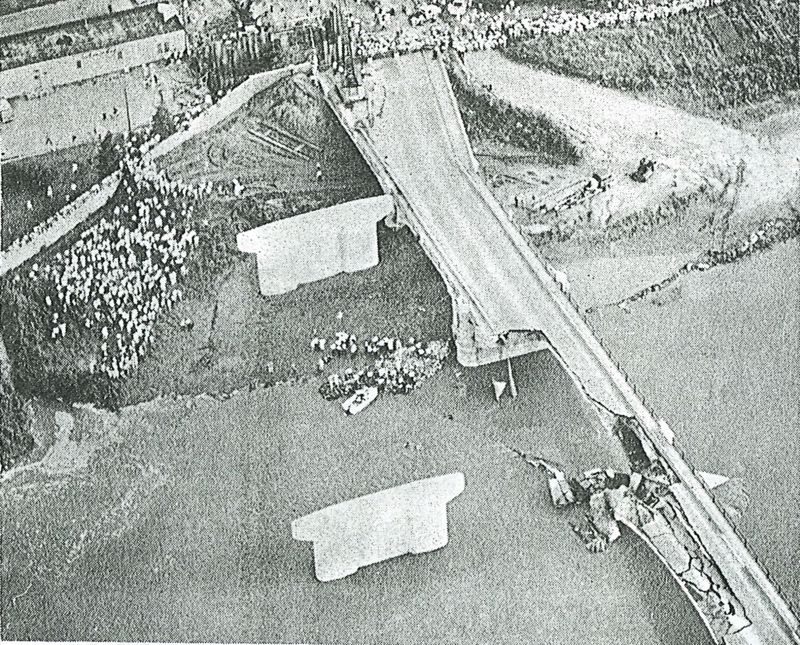 An aerial view of the collapsed section of the Melan bridge. Rescue workers can be seen in the water while a large crowd watches from the shore. (TSCPL)
Several cars were able to successfully back up and avoid the massive chasm that opened up, but one car was not so lucky. Kenneth Allen, an employee at the North Topeka Ed Marling’s, was on the section that collapsed and his car plunged into the river. Topeka policeman Ed Leo dove into the swollen river to try to rescue Allen, but he was already dead by the time Leo reached the upturned vehicle.
Several witnesses reported another vehicle had gone into the water along with Allen’s. Rescue workers and divers dredged the river for the next several days, but a second car was never recovered.
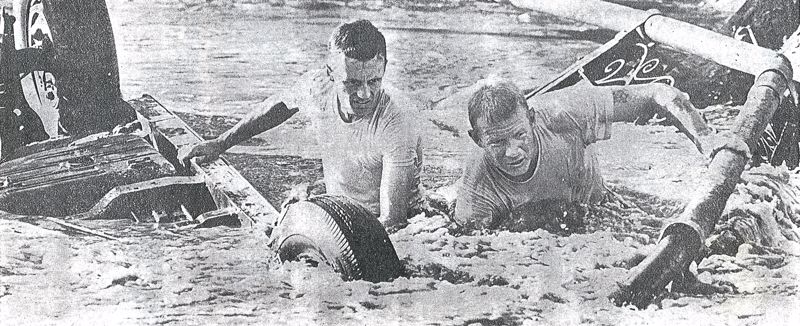 Topeka policemen Ed Leo (left) and John Miller (right) attempted to save Kenneth Allen, who was the only known fatality of the bridge collapse. (TSCPL)
The collapse of the Melan bridge spurred city officials to inspect every public bridge in the city. Several were found to be unsafe and a reconstruction program was undertaken. Construction of the new Kansas Avenue bridge wasn't completed until 1967. North Topeka merchants complained that the new bridge hurt their business since it did not connect directly to Kansas Avenue. It took several years before a flyaway was constructed to better facilitate access to the North Topeka business district and the Great Overland Station.
To learn more about the Melan bridge visit our local history collections database.